Design your Frontier Firm. Then adopt it.
Microsoft, McKinsey and BCG all agree: the AI-first organization isn't an org chart, it's a work chart — hybrid human-agent teams, measurable agent-to-human ratios, and different functions operating at different AI-maturity stages simultaneously. Fronterio is where you design it.
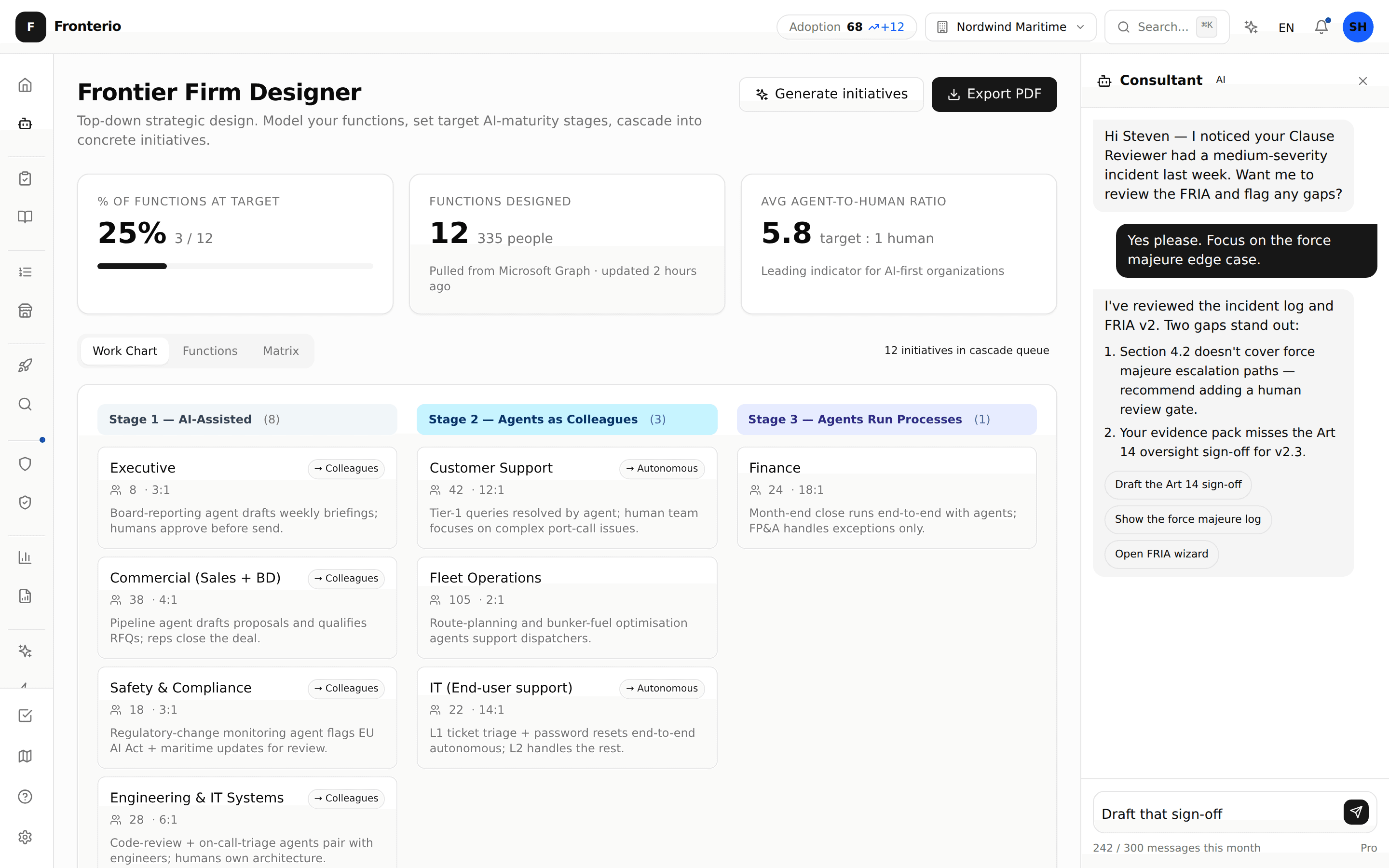
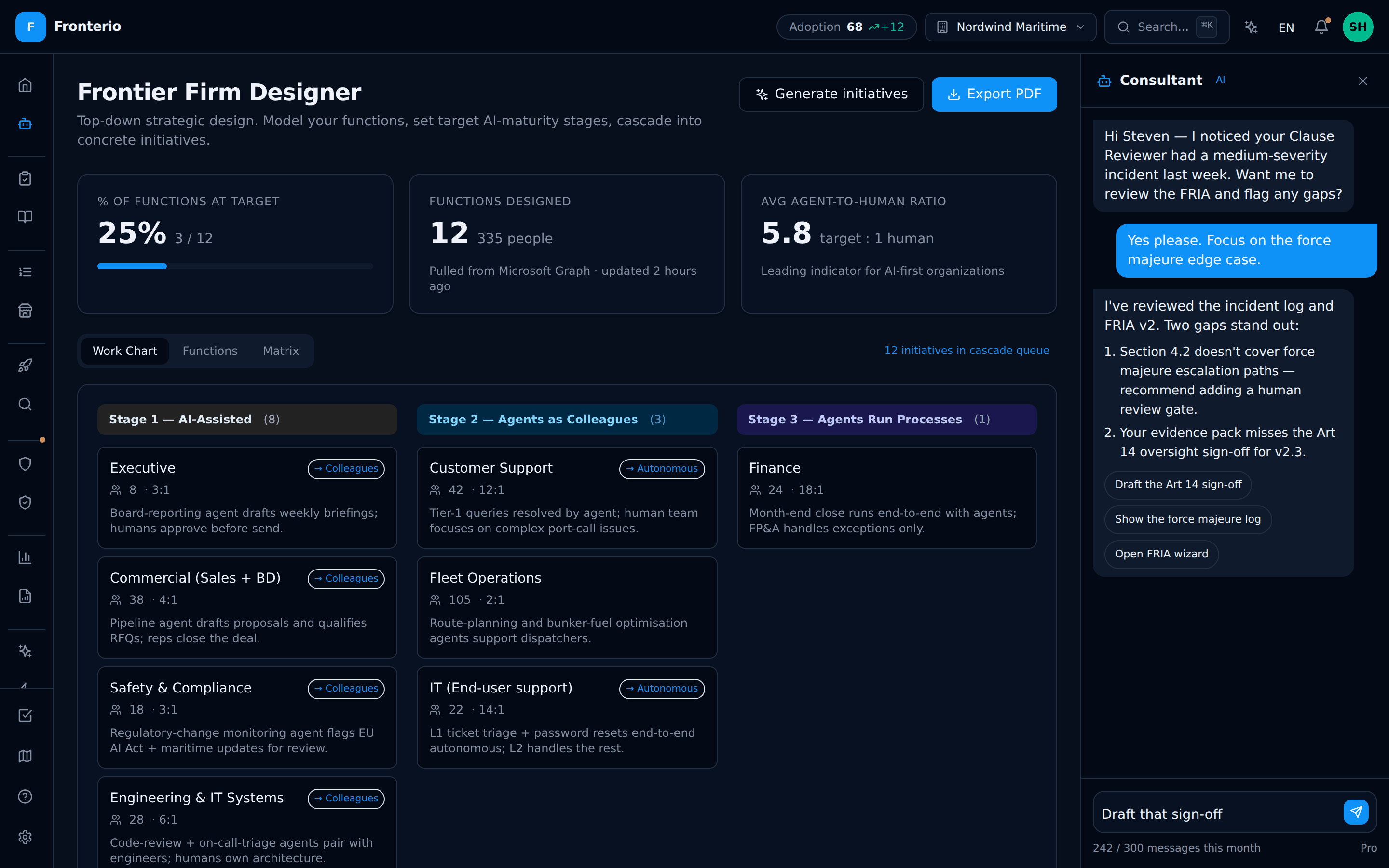
Per-function Frontier Firm maturity (Assisted → Colleagues → Autonomous)
Average time to a designed target operating model
vs McKinsey or BCG’s consulting version of this exercise
What a Frontier Firm actually is
Microsoft’s 2025 Work Trend Index describes the Frontier Firm in three stages: Stage 1 every person uses AI as a tool; Stage 2 agents join as digital colleagues on specific tasks; Stage 3 agents run bounded processes while humans set direction and handle exceptions.
The crucial insight is that different functions inside the same company operate at different stages at the same time. A finance team might be at Stage 3 for month-end close while sales is still at Stage 1. Designing AI transformation means designing per-function.
Agent-to-human ratio is the new leadership KPI. McKinsey’s Agentic Organization model and Eccles’ Hybrid Intelligence Teams framework both converge on the same number: two to five humans supervising ten to one hundred agents at the mature end of the curve.
Fronterio models your business functions as first-class entities — each with a current stage, a target stage, an agent-to-human ratio, and a narrative of what moving up the curve unlocks, requires, and risks.
When you’re happy with the target state, Fronterio cascades the design into concrete initiatives: proposed use cases in the registry, proposed agents in governance, playbook milestones with auto-generated tasks, and — where relevant — the deployer obligations that higher stages trigger under the EU AI Act.
Strategy and execution share the same substrate. Your work chart isn’t a slide deck that drifts out of date; it’s the live index page for the rest of the platform.
Top-down design vs bottom-up governance
Without Fronterio
- AI strategy lives in a board-deck PDF that nobody updates
- McKinsey / BCG engagement: €500K–€2M, six months to deliverables, no refresh
- Every use case and agent proposal is bottom-up, one-at-a-time, uncoordinated
- No concept of per-function AI maturity or agent-to-human ratio
With Fronterio
- Living work chart: per-function stages + ratios that update as the platform fills in evidence
- €299–€699/month, 4-minute time-to-value, refreshes every time your org changes
- Target state automatically generates use cases, agents, playbook milestones — execution follows the design
- Stage transitions trigger the right EU AI Act deployer obligations (Art 4 literacy, Art 14 oversight, Art 27 FRIA)
What’s inside the Designer
Function map
Every business function as a first-class entity with headcount, lead, current and target stage.
Microsoft 365 sync
Pull your real org structure from Microsoft Graph — departments, headcounts, leads — without a spreadsheet.
AI-proposed map
No Microsoft tenant? Fronterio proposes a realistic function map from your industry, size, and existing signals.
Three-stage framework
Stage 1 Assisted, Stage 2 Colleagues, Stage 3 Autonomous — set independently per function.
Target-state narrative
For every function you design, the AI writes what Stage 2 or 3 actually unlocks, requires, and risks.
Agent-to-human ratio
The new leadership KPI. Set a target, track the current, watch the gap close as you deploy agents.
Initiative cascade
One click turns the design into use cases, agent proposals, and playbook milestones — tagged and traceable.
Work chart visualization
A board-ready diagram of your functions, stages, and dependencies. Screenshot it, paste it into your quarterly review.
EU AI Act compliance linkage
Stage 2 triggers Article 4 literacy; Stage 2 + high-risk agents trigger Article 14 oversight; Stage 3 triggers Article 27 FRIA.
Living, not one-shot
The design stays in sync as you deploy agents, complete assessments, and mature. No consultant needed for the refresh.
Evidence-first progression
Current-stage auto-detection reads your agents, assessments, and policies. No self-attestation theatre.
Partner-led consulting lift
Consultants run the Frontier Firm Diagnostic in one session and have a co-designed roadmap the same day.
From blank org to designed Frontier Firm
Map your functions
Connect Microsoft 365 (pulls directory) or let AI propose a function map from your industry and size. Edit freely.
See where each function stands today
Fronterio auto-detects current stage per function from agents, assessments, and policy signals. Confirm or override.
Design the target state
Set target stage and agent-to-human ratio per function. A per-function narrative generates as you adjust.
Cascade into execution
Click Generate Initiatives. Fronterio creates use cases, proposed agents, and playbook milestones tagged to the design.
“The work chart replaces the org chart. It’s not a slide — it’s a living dashboard of how humans and agents are organized to create value.”
Available on
Pro unlocks the design workspace. Business unlocks AI generation + Microsoft Graph sync.
Design yours in four minutes
Start with our free AI readiness assessment. Upgrade to Pro to design your target state. Upgrade to Business to cascade initiatives automatically.