An AI that remembers your organisation.
Every assessment, agent, policy, initiative, decision, and experiment across your Fronterio tenant teaches the platform. Overnight it turns what happened into durable knowledge about your organisation — preferences, patterns, risks, momentum — and into recommendations that arrive with your context already in them.
Fact types the engine tracks per organisation, from risk signals to stated aspirations
Surfaces the recommendations appear on: consultant, Home, digest, Opportunities
K-anonymity floor for every cross-customer insight. Identity never leaves your tenant
How the Memory Engine works
Every action your team takes on Fronterio writes a validated, immutable signal — no raw user IDs, no free text, only a bounded set of fields. Every night the platform reads the new signals for your organisation and feeds them through a two-stage consolidation.
Stage one is deterministic: five rule-pass detectors scan for patterns a spreadsheet could catch, such as policy-publish streaks, assessment-score drops, agent-deploy cadence, initiative ship rate, and guide-completion rhythm. These produce candidate facts with evidence trails pinned to specific signal rows. Stage two is a frontier AI model, gated to Pro+ and only called when new signals or a consultant-inferred fact justify it. The model looks at your bucket context, prior facts, and recent signals and returns up to twelve additional candidates: subtle preferences, stated aspirations, and decision contexts the rule-pass can't see.
Candidates merge into a durable memory with supersede semantics: the same fact at higher confidence reinforces, a different value supersedes. A canonical 55-key vocabulary prevents drift; anything off-vocabulary lands in an admin review queue instead of polluting your memory. Facts carry confidence bands, evidence signal IDs, and an expiry per fact type: blockers expire in 14 days, constraints in a year.
Recommendations compute from memory, current state, and (Business+) cross-customer cohort patterns. A single recommendation can opt into four surfaces: your consultant prompt (top five), your dashboard home card (top three), your weekly digest email (high priority only), and Opportunities (full list). One source of truth, four renderings, always in priority order.
Why memory, not just analytics
Without the Memory Engine
- A generic AI assistant starts every conversation from scratch. It knows your score but not your preferences, history, or decisions
- Pattern detection happens in someone's head. Churn risks, stalled initiatives, and capability gaps sit in memory until a meeting surfaces them
- Every dashboard widget answers "what happened" but nothing answers "what you should do next, grounded in what you've done"
- Peer benchmarks are stale PDFs; "what orgs like us typically do" lives in a consultant's LinkedIn DMs
With the Memory Engine
- Ask Fronterio cites learned facts by fact_type with confidence markers, grounded in your organisation's record — and stops repeating the same question every conversation
- Risk signals surface the morning they qualify, with evidence linking back to the specific agent incidents or score drops that triggered them
- Every surface (Home, digest, Opportunities) reads from one recommendation set, ordered by priority, auto-dismissed when no longer relevant
- Cross-customer cohort insights (Business+) are bucket-only with k≥15 anonymity: useful patterns, zero identity leak
What ships with the Memory Engine
Learned facts per organisation
Preferences, patterns, relationships, constraints, commitments, risk signals, aspirations, capability gaps, blockers, momentum, cohort insights: structured knowledge of how your organisation actually works.
Rule-pass + AI consolidation
Deterministic detectors for every org; Pro+ adds a nightly AI pass with strict, validated output.
Template-driven recommendations
Declarative templates map fact types to recommendations with plan-tier priority boosts, CTA links, auto-dismissal when the underlying fact clears.
Four rendering surfaces
Consultant prompt injection, Home attention stack, weekly digest section, the Opportunities ranking: same source, different priorities.
Privacy by design
Salted hashing per organisation, a strictly validated emit boundary, and bucket-only cohort aggregation with a k≥15 anonymity floor.
Opt-out honoured at every layer
cohort_contribution_enabled flip excludes an organisation from both cohort writes and reads: no data leaves your tenant without explicit consent.
Bring your own AI (Fronterio Atlas)
Ground Copilot, Claude, Cursor and your own agents on your governed Fronterio context over a secure MCP endpoint: your org's facts, priorities and posture, with no PII ever leaving the platform. Pro and above.
How it lands in your tenant
Signals start flowing
From day one, every assessment, agent approval, policy publish, guide completion, decision, and experiment emits a validated signal.
First consolidation run
Day two at 05:00 UTC: the rule-pass finds its first patterns, seeds the first organisation_memory rows. Consultant starts citing them.
Recommendations appear
Within a week, Home and Opportunities show your first recommendations. The digest includes high-priority items every Monday.
AI pass kicks in (Pro+)
When signal volume or consultant-inferred facts justify it, our AI model adds the subtle facts: preferences, aspirations, decision contexts detectors can't see.
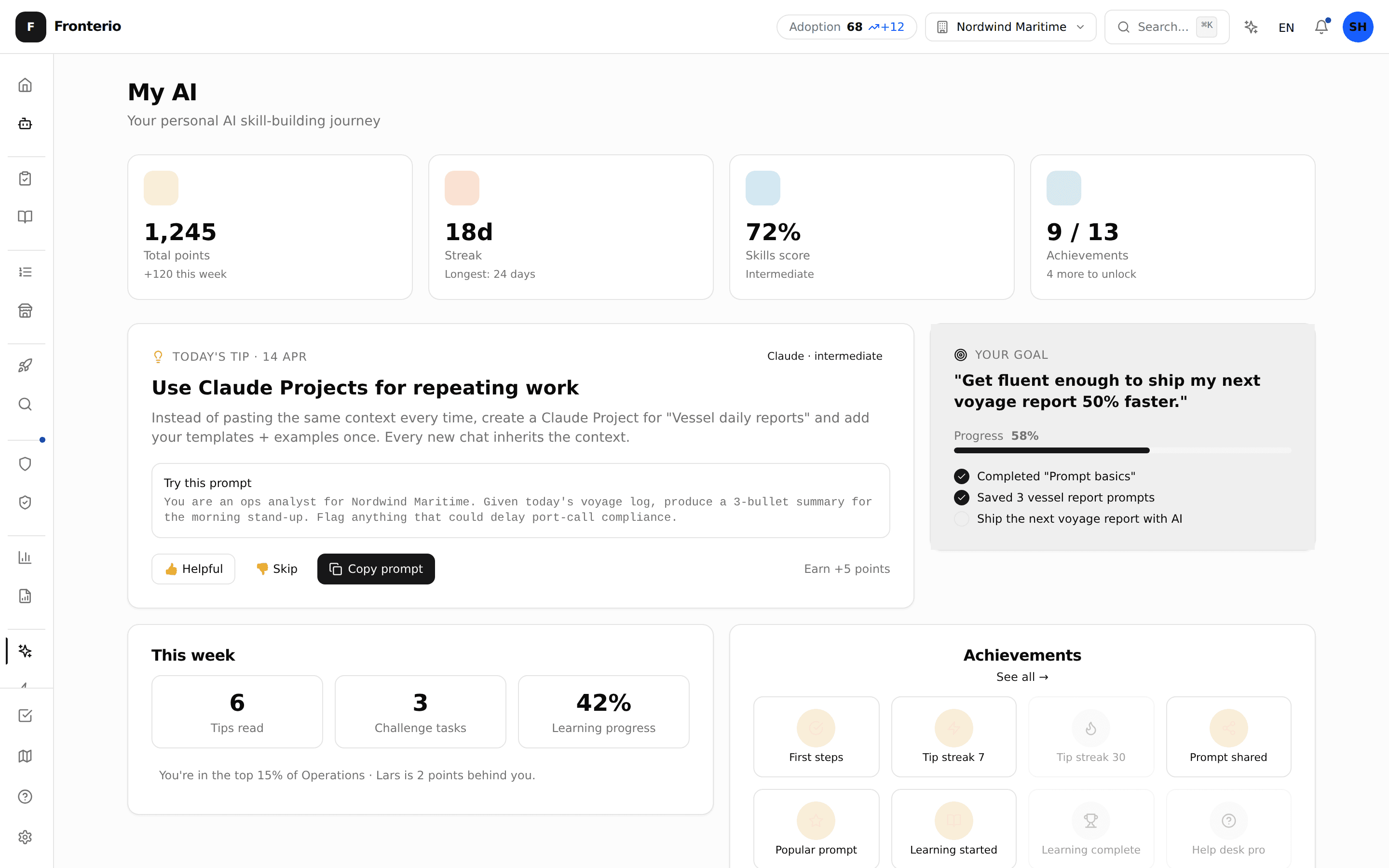
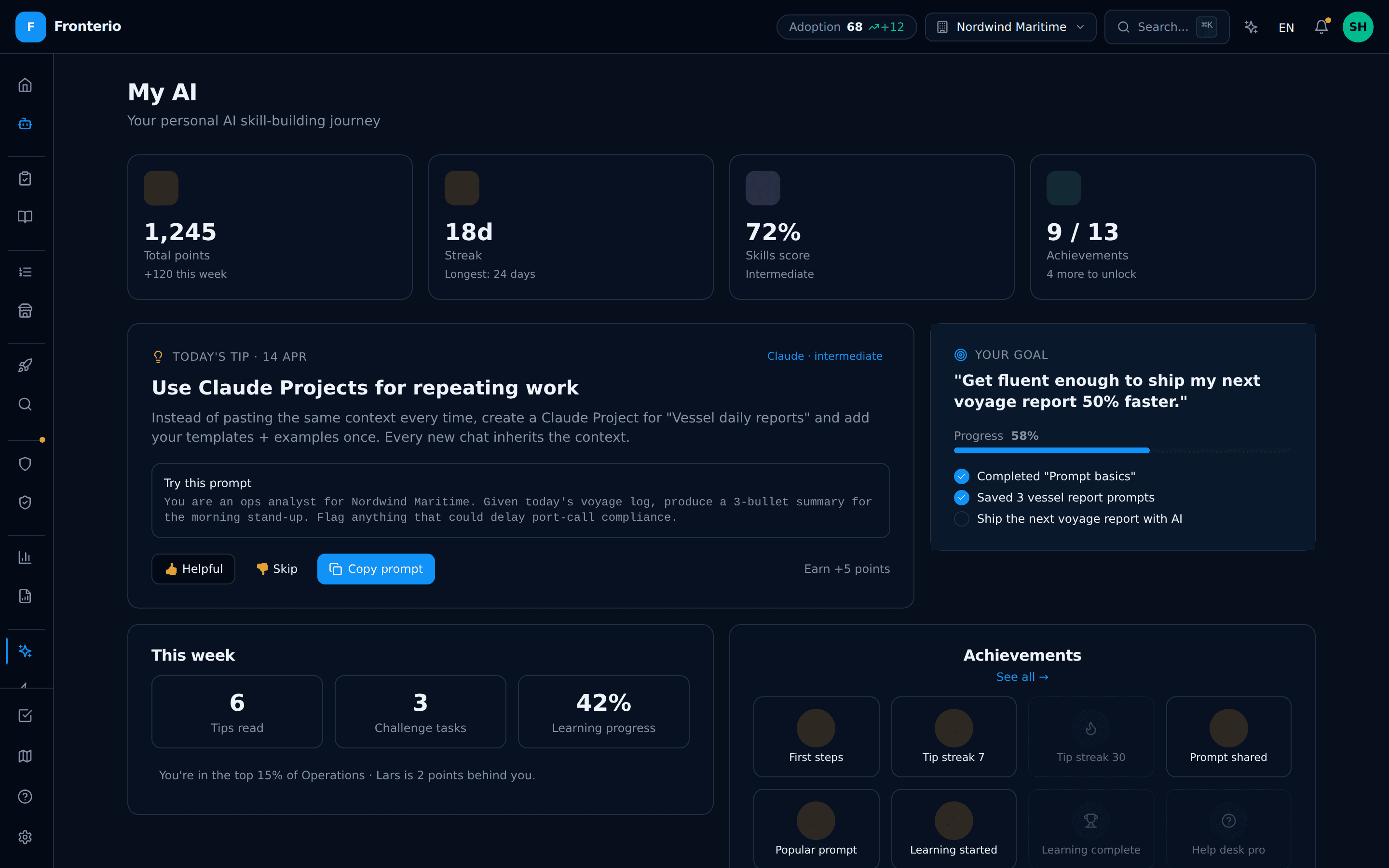
“Most AI tools have to be re-briefed on the organisation every time. The Memory Engine remembers instead. It carries forward what it learned, and it flags drift nobody has noticed yet.”
How the Memory Engine works
Available across Pro, Business, and Enterprise
Rule-pass + consultant injection ships to every plan. Pro+ unlocks the nightly AI consolidation pass and Home recommendations. Business+ adds predictive cohort insights. Enterprise adds cross-customer risk-signal predictions and Brain API access.
Give your AI a memory.
Book a walkthrough and see what the engine would learn about your organisation in its first week.