Use AI to improve public services with evidence and accountability built in
The value pools in the public sector sit in case handling, document processing, citizen service and internal administration: work measured in waiting times and backlogs. The bar for accountability is the highest anywhere, because every AI decision affecting citizens must withstand scrutiny. Fronterio finds the opportunities, manages the change, and produces the transparency and audit evidence that keeps public trust as you deliver.
Where AI creates value in the public sector
Government agencies are deploying AI to improve citizen services, reduce administrative burden, enhance decision-making, and allocate resources more effectively. From immigration processing to social services, tax administration to emergency response, AI is transforming how governments serve their citizens.
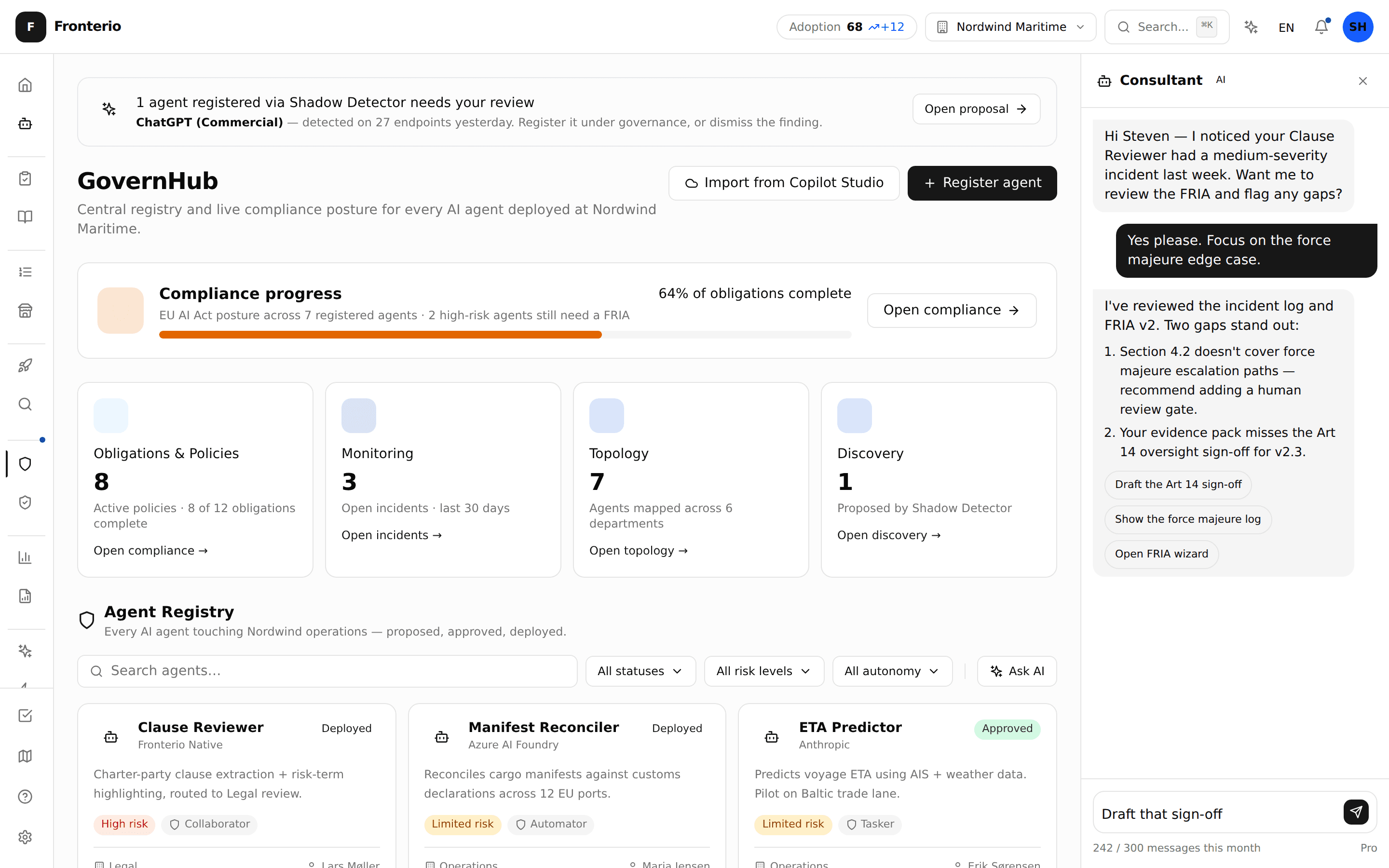
But government AI faces the highest scrutiny. The EU AI Act requires Fundamental Rights Impact Assessments (FRIAs) for public sector AI in areas like social benefits, law enforcement support, and immigration. Fronterio's FRIA wizard guides your team through this process step by step, with AI-assisted drafting.
Transparency is non-negotiable. Every AI tool used in citizen-facing services must be documented with clear explanations of its purpose, data usage, limitations, and human oversight. Fronterio's governance registry provides this transparency layer, accessible to auditors, oversight bodies, and citizens.
The compliance dashboard tracks all deployer obligations under the EU AI Act: human oversight, AI literacy training, data governance, transparency, and incident reporting. Your team sees exactly what's complete, what's in progress, and what needs attention.
Ask Fronterio understands public sector governance: procurement processes, democratic accountability, interdepartmental coordination, and the specific regulatory obligations that apply to government AI deployers. It helps your team navigate this landscape with practical, actionable guidance.
The public sector difference
Without Fronterio
- No standardised AI governance framework across departments
- FRIAs and compliance documentation created from scratch each time
- Limited transparency into AI tools used in citizen services
- AI literacy training untracked across a large public workforce
With Fronterio
- Government-wide AI governance framework with department-level tracking
- FRIA wizard with AI-assisted drafting and reusable templates
- Complete transparency registry for all citizen-facing AI tools
- AI literacy tracking across entire workforce with completion reporting
Key capabilities for government
FRIA & Regulatory Compliance
Guided Fundamental Rights Impact Assessment wizard for all high-risk public sector AI. AI-assisted drafting, reusable templates, and regulatory-ready documentation.
Citizen Transparency Framework
Build a public-facing AI transparency registry. Document every AI tool's purpose, data usage, limitations, and human oversight, ready for citizen inquiries and auditors.
Cross-Department Governance
Unified AI governance across multiple departments and agencies. Consistent standards, department-level dashboards, and government-wide reporting and analytics.
Public Sector Compliance
Full EU AI Act deployer obligations tracking. AI literacy training for public servants, incident reporting, data governance, and audit-ready compliance documentation.
Where public sector organisations put AI to work
Citizen Service Automation
Govern AI chatbots and automated service portals. Ensure transparency disclosures, track citizen satisfaction, and maintain human escalation paths for complex cases.
Benefits & Social Services AI
FRIA-required AI for benefits determination, eligibility assessment, and resource allocation. Document fairness protections, bias monitoring, and human oversight for consequential decisions.
Document Processing & Administration
Register AI for permit processing, records management, and administrative automation. Track processing time improvements and error rate reductions.
Public Safety & Emergency Response
Govern AI used in emergency response coordination, resource allocation, and public safety planning. Safety-critical classifications with enhanced oversight requirements.
Policy Analysis & Decision Support
Manage AI tools that support policy analysis, budget modelling, and strategic planning. Document methodology, data sources, and limitations for democratic accountability.
Get started in government
Find where AI creates value
Run the free AI Value Scan grounded in public-sector patterns. See what case handling, document processing and administration cost today, and where AI could shorten queues.
Prioritise the opportunities
Compare value, feasibility and risk in one ranked list. Citizen-facing AI carries its FRIA and transparency requirements in the decision from day one.
Deliver with accountability built in
Turn the decision into managed change. Risk classification, FRIAs, oversight plans and the audit log accumulate as you deliver: evidence for oversight bodies by construction.
Prove the result
Compare the baseline with what came back: processing times, backlog, service quality. Results you can show citizens and oversight bodies alike.
“Government AI must serve citizens, not the other way around. Transparency, accountability, and human oversight aren't bureaucratic requirements. They're democratic obligations.”
How Fronterio serves government
See what AI could return to public service
Free AI Value Scan grounded in public-sector patterns. See where AI could create value across your agency in minutes.